TEACHING
Stanford University · 2025 - Present
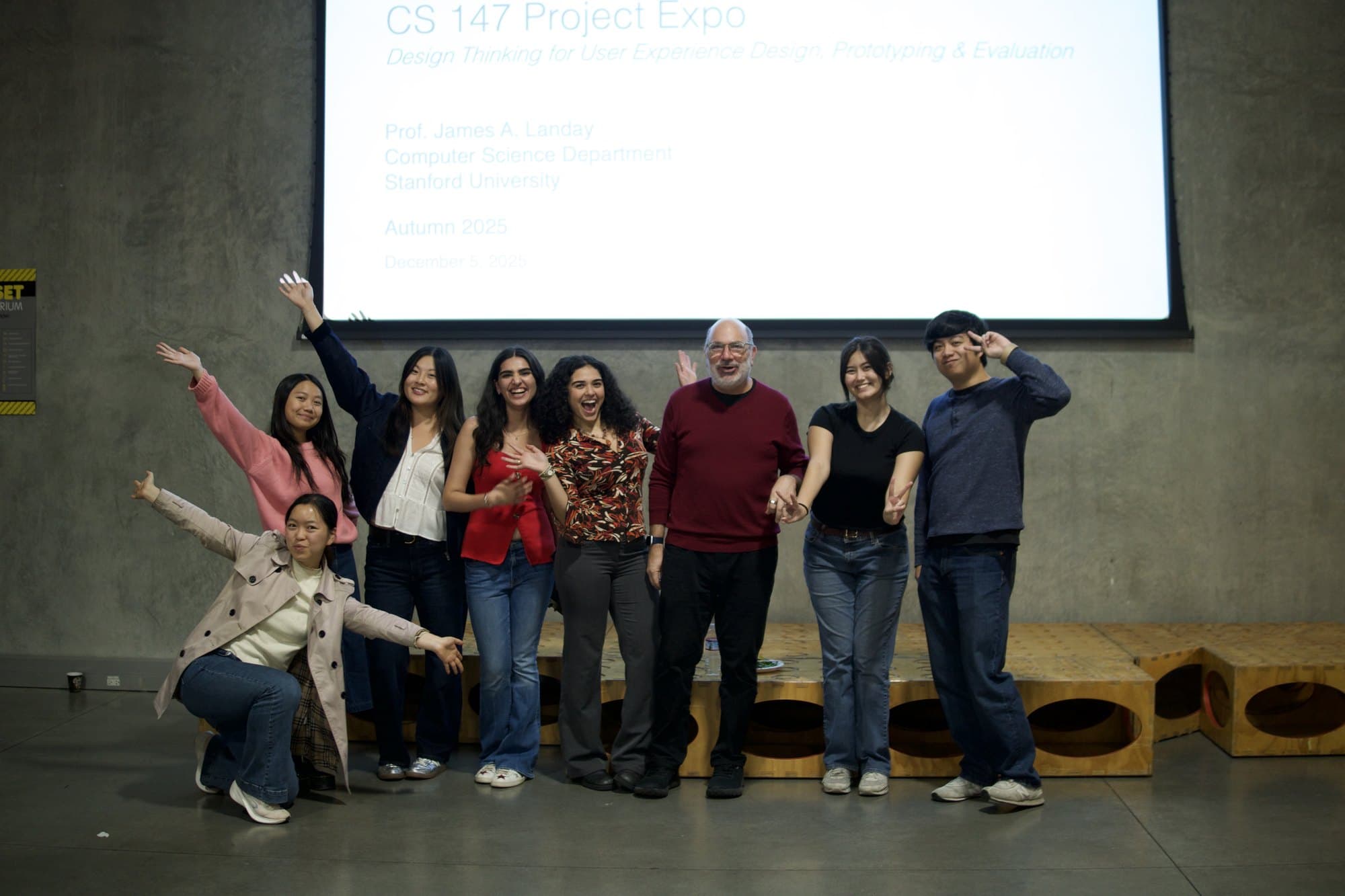
The CS 147 Project Expo, the final project expo for Stanford’s core Interaction Design course. I was a Teaching Assistant for this course in Autumn 2025.
I am a Visiting Lecturer at Stanford’s Computer Science Department. I created and will teach CS 91: Interaction Design for AI-Native Products.
CS 91: Interaction Design for AI-Native Products
Visiting Lecturer · 2026 - Present
A ten week course I created on the design challenges and considerations of building AI native products: trust, observability, ease of use, multimodal interfaces, agentic consumer and developer tools, and conversational UI patterns. This course's first installment will be taught in Spring 2027.
CS 91SI: Digital Canvas: Intro to UI/UX
Graduate Lecturer · 2025
I built and taught this ten week introduction to UI and UX design. The class produced twelve student projects.
CS 147: Intro to User Experience Design, Prototyping and Evaluation
Teaching Assistant · Autumn 2025
I coached four project teams through critique and iterative prototyping, from early needfinding to the final shipped product.
CS 377U: Understanding Users
Teaching Assistant
Supporting the course on methods for conducting usability and user research, and turning user insights into product components, interactions and features that solve real user problems.
Student notes
From CS 91SI: Intro to UI/UX Design, which I was Graduate Lecturer for.
I had the pleasure of taking CS 91SI with Diya Sabharwal in Winter 2025, and she was an excellent instructor. If I hadn't known otherwise, I would have mistaken her for someone teaching straight out of industry; she has a mature, grounded teaching style and a clear sense of how design and HCI work in practice.
Diya was consistently supportive and patient, and she regularly stayed over time to iterate through the material with us until it clicked. The course she built was well organized and genuinely practical: I came away having assembled a library of UI/UX design tools that I now use in my other classes. More importantly, the class shaped how I think about design and gave me enough of a toolset to design and ideate independently.
She also brought in thoughtful guest speakers from both startups and larger companies, whose insights connected the course material to the real direction of the field.
I'm writing to recommend Diya Sabharwal as an instructor without much hesitation. I took her course, CS 91SI, during my freshman fall at Stanford, and it's genuinely one of the reasons I decided to continue pursuing design.
Before the class, I had surface-level exposure to design thinking, but CS 91SI was the first time I felt like I was learning how design actually works in the real world. Diya structured the course around projects that felt grounded and realistic rather than hypothetical exercises, which made a huge difference in how much I retained. I walked away understanding end-to-end UX, research, interaction design, prototyping, the whole pipeline as a coherent process I could actually apply to my internships later that year, and this year.
I highly appreciated how hands-on Diya was as an instructor. Her feedback was specific and actionable. She clearly cared whether each student actually understood what they were doing, and that investment showed. She has a way of making complex concepts feel approachable without dumbing them down, and she stayed engaged throughout the quarter in a way that made the class a real mentorship experience.
I'm now a rising junior studying Design, and I can trace a lot of how I think about UX, both the tactical craft and the bigger picture of what good design is trying to do, back to that class. I believe Diya would bring that same clarity, care, and rigor to any teaching role she takes on.
I had an amazing time in the class. It really made me realize I had the ability to make the change I wanted to see in one of my projects. I looked at Locket, which is an app I use a lot with my friends from home, and thought about ways to make it more interactive, to make me feel like I could be more connected to them despite the fact that I'm across the country. It was a very fulfilling experience to realize how much UX/UI design goes into our everyday lives and how we have the ability to change the way technology is impacting us by the way we design things. I think it's a class that many people need to take, because I feel like oftentimes, in the midst of AI, people feel like they have less of a say in how society is going to be. This class made me realize that that's not the case, and it's not as difficult as I thought to create the things I want to see.
I still remember when I was first trying to understand where I belonged within the field of Human-Computer Interaction. In Winter 2025, I was searching for classes that could help me explore both the creative and technical sides of UX/UI design. I posted in the Design Kids at Stanford Slack asking for recommendations, and Diya was the first person to respond. She didn't just suggest a class, she personally invited me to join hers that quarter: CS91SI. That small act of openness ended up having a much bigger impact on my academic path than I could have expected.
From the very beginning, what stood out about Diya was her patience and the way she genuinely cares about how students learn. In her class, I had the chance to work on projects ranging from redesigning interfaces in Figma to applying practical design methods to products like Spotify and Telegram, as well as experimenting with my own ideas (creating the UI of a language-learning app) and other small interactive prototypes. Through those experiences, I realized that product and interface design was not just something I enjoyed, it was something I wanted to genuinely dedicate my career to.
But what makes Diya truly special goes beyond her technical expertise. She creates an environment where curiosity feels welcome, and questions are encouraged. Even outside the classroom, she was always willing to take the time to answer my questions about navigating Symbolic Systems and exploring HCI more deeply. Those conversations mattered a lot during a moment when I was still figuring out my career directions and the resources that a huge university like Stanford brings along!
On a more personal level, Diya's journey has always felt especially meaningful to me. As fellow international students trying to find our place in technical and creative spaces, there are moments when the path can feel uncertain or isolating. Seeing someone like Diya navigate it with both excellence and empathy meant a lot to me. She leads not only with talent but with genuine care for the people around her. Diya has a sharp design intuition and an incredible attention to detail, but what truly sets her apart is her kindness in the way she creates space for others to ask questions, grow, and feel supported, even when they're still figuring things out (like I used to)!! That kind of mentorship stays with you long after the class ends!